What to Do When Your Parents' Memory Starts to Fade
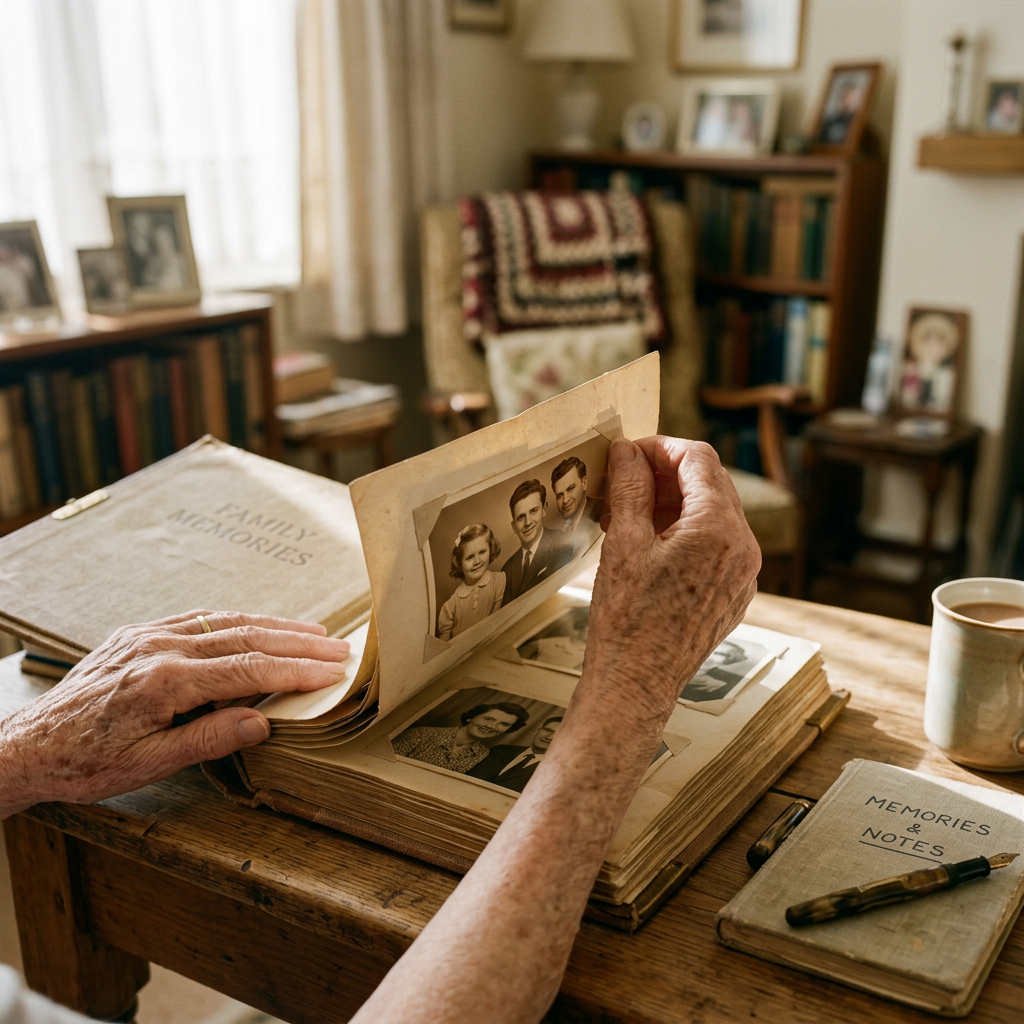
Memory loss in a parent is one of the most disorienting things a family can face. Here's what the research actually says, what you should do first, and why the window for capturing their stories matters more than most families realize.
What to Do When Your Parents' Memory Starts to Fade
There is a particular kind of fear that settles in quietly.
It doesn't arrive with a diagnosis. It arrives earlier, in small moments you almost explain away. Your father tells the same story he told an hour ago, and you catch yourself wondering if he knows. Your mother can't find the word she's looking for, and it takes longer than it used to. You watch them hesitate in a familiar place, and something in you goes still.
You don't say anything. You're not sure what to say. You're not even sure what you're seeing yet.
This post is for that moment, and for everything that follows it. Not as a medical guide, but as a practical and honest account of what memory loss in a parent actually means, what the research shows, and what you can do, starting now, that will matter in ways you may not fully appreciate until later.
First: Understand What You're Actually Seeing
Not all memory changes are dementia. This matters because fear can cause families to either dismiss real warning signs or catastrophize normal aging, and both responses delay the help that's actually needed.
The National Institute on Aging distinguishes clearly between the two. Normal aging involves thinking slowing down, needing more time to recall names or learn new information, and occasionally forgetting where you put something but remembering later. These are frustrating but expected changes in a healthy aging brain.
Dementia is different in kind, not just degree. The Alzheimer's Association describes early warning signs that go beyond forgetfulness: disruption to daily functioning, repeated questions within a short span, getting lost in familiar places, difficulty completing familiar tasks, significant changes in mood or personality, and problems with language that go beyond occasional word-finding difficulty.
The distinction matters because the two situations call for different responses. If what you're seeing is normal aging, the most useful thing you can do is stay engaged, keep the relationship rich, and resist the urge to treat your parent as more fragile than they are. If what you're seeing crosses into something more concerning, the most useful thing you can do is get a proper evaluation from a physician sooner rather than later, because early intervention matters.
What both situations share is this: the window for meaningful connection, and for capturing what your parent knows and remembers, is open right now. And it is worth treating that window as precious regardless of what the diagnosis eventually turns out to be.
What Memory Loss Actually Takes, and What It Leaves Behind
Here is something the research shows that most families don't know, and that changes everything about how you approach a parent with memory loss.
Not all memory is the same. Dementia, including Alzheimer's disease, disproportionately attacks what researchers call declarative memory: recent events, new information, names, dates, the kind of factual recall we tend to think of when we think of memory. What it tends to leave intact much longer, often well into moderate stages of the disease, are older, deeply encoded memories: childhood, early adulthood, emotionally significant experiences, procedural skills like music or cooking, and the emotional texture of relationships.
Research published in PMC on emotional memory in Alzheimer's patients found that people with the disease often preserve the ability to store and respond to emotionally significant events far longer than their ability to recall neutral information. In practical terms: your parent may not remember what they had for breakfast, but they may still remember vividly what their mother's kitchen smelled like, the name of their first teacher, the way they felt on their wedding day.
This is not a small thing. It means that even after significant cognitive decline, there is still something there. Still stories accessible, still connections possible, still a person present in ways that a focus on what's been lost can make invisible.
It also means that the conversations worth having are not the ones that require sharp recent memory. They are the ones that reach for the older, deeper material. And those conversations become more important, not less, as the disease progresses.
What Reminiscence Therapy Actually Is
Reminiscence therapy is a structured approach to engaging people, particularly those with memory loss, through deliberately evoking long-term memories using prompts: old photographs, music from a particular era, familiar objects, sensory triggers, questions about the past.
It has a substantial and growing body of research behind it. A 2025 meta-analysis in the Journal of the American Medical Directors Association found that reminiscence therapy significantly improved cognitive function in people living with dementia, with a standardized mean difference of 0.74, a clinically meaningful result. Studies consistently show reductions in depression, improvements in quality of life, and better social engagement among participants.
You do not need to be a therapist to use these principles. What you need is a genuine curiosity about the past, a few well-chosen prompts, and the willingness to follow the story wherever it goes rather than correcting, redirecting, or rushing.
Old photographs are among the most reliable triggers. So is music from the decade your parent came of age. So are specific sensory questions: what did your childhood home smell like? What did your mother cook on Sundays? Where did you go on your first date?
These questions reach past the damaged layers into something older and more resilient. They often produce not just answers but full, vivid narratives that the person telling them may not have accessed in years. And they offer the person with memory loss something genuinely rare: the experience of being competent, of knowing something, of holding a story that belongs to them and nobody else.
The Conversation You Should Have Before You Can't
There is a window that most families don't know is closing until it has closed.
When memory loss is mild, or in the early stages, the person you love is still largely themselves. Their long-term memories are still largely intact. Their personality, their humor, their values, the particular way they see the world: still present, still accessible, still capturable.
This is the time to have the conversations that will matter most to everyone who comes after.
Not because it feels urgent. It may not feel urgent at all. Your parent may seem fine most days. The idea of sitting down and formally recording their life story may feel premature, even melodramatic.
But the families who waited, who assumed there was more time, who kept saying they'd do it after the next holiday or the next visit, are the families who come to me with the particular kind of grief that has no name. Not the grief of loss, exactly. The grief of the unanswered question. The story that was almost told. The person who was almost fully known.
The conversations don't have to be formal. They don't have to feel like a project. They can start as simply as pulling out an old photograph and asking about it. What was happening here? Who are these people? Where were you going? What do you remember about that time?
Let the story come. Record it if you can, even just on a phone sitting quietly on the table. Ask the question that leads to the next question. Be less interested in the facts and more interested in the feeling. What was it like? What do you wish you'd known? What are you proud of?
These are not small conversations. They are the ones that will outlast everything else.
What to Do Right Now: A Practical Guide
Get a medical evaluation if you haven't.
If the changes you're seeing go beyond occasional forgetfulness, the first step is talking to your parent's primary care physician and requesting a cognitive assessment. Early diagnosis matters. It opens access to interventions, support, and planning that can significantly affect the quality of the years ahead. It also gives you and your family honest information to work with.
Don't stop the conversations because it feels awkward.
One of the most common responses to early memory loss is a kind of protective avoidance. Family members stop asking certain questions, stop referencing the past, start managing interactions to prevent confusion or distress. This is understandable. It is also, in many cases, a mistake. Research consistently shows that engagement, reminiscence, and meaningful conversation support cognitive and emotional wellbeing in people with memory loss. The goal is not to protect them from their story. It is to stay in it with them.
Use sensory triggers deliberately.
Photographs. Music. Familiar smells. Objects from the past. These are not just conversation starters. They are access points to a layer of memory that often remains intact long after recent recall has deteriorated. A song from a parent's youth can unlock a story that no direct question would reach. Use them intentionally.
Record what you can, while you can.
You don't need a production setup. A smartphone on a table, a quiet room, a patient and curious conversationalist. That is enough to capture something irreplaceable. Record the voice. Record the specific words they use. Record the laugh in the middle of a story. The quality of the audio matters far less than the fact of having it.
If your parent is still in the early stages of memory loss, or if the changes you're seeing are within the range of normal aging, the window for a full and rich recording is wide open. The stories are there. The personality is there. What is needed is someone willing to ask.
Take care of yourself too.
Watching a parent's memory fade is a particular kind of grief, and it compounds over time. The person is still present, and yet something is changing in ways that are hard to name. This is a recognized psychological experience, sometimes called anticipatory grief or ambiguous loss. It deserves acknowledgment, not just management. Caregiver support groups, conversations with a therapist, and honest conversations within the family about what everyone is experiencing can make an enormous difference in your capacity to show up well for the person who needs you.
What This Season of Life Is Actually Asking of You
I have been realizing, more and more, that the families who navigate this well are not the ones who have the most resources or the best medical access or the most carefully organized care plans. They are the ones who stay curious. Who keep showing up not just as caregivers but as witnesses. Who believe that the person in front of them, even as the disease takes more and more, is still worth knowing.
That posture, of genuine curiosity rather than management, of listening rather than correcting, of presence rather than efficiency, turns out to be both the most loving and the most effective thing a family can offer.
The stories that emerge from that posture are the ones that last. They are the ones grandchildren will read decades from now and feel, unmistakably, that they are in the presence of a real person. Someone who was afraid and funny and stubborn and loving in ways that no summary could capture.
That is what is still possible, even now, even in this.
But it requires starting. And starting requires believing that what is still there is worth reaching for.
It is.
At Life Story Guide, we work with families at every stage, including families navigating memory loss. Our expert conversational guides are trained to reach the stories that are still there, using the questions and approaches that work best when time and memory are both precious. If you'd like to explore what that looks like for your family, we'd love to talk. Start with a free trial conversation at lifestoryguide.com
— Aby C. Abraham
Founder, Life Story Guide · Author, The Strangers We Love